A Useful Herb Bed Beside the Kitchen Door
Plan a compact kitchen herb bed around observed light, easy access and the herbs your household actually uses.
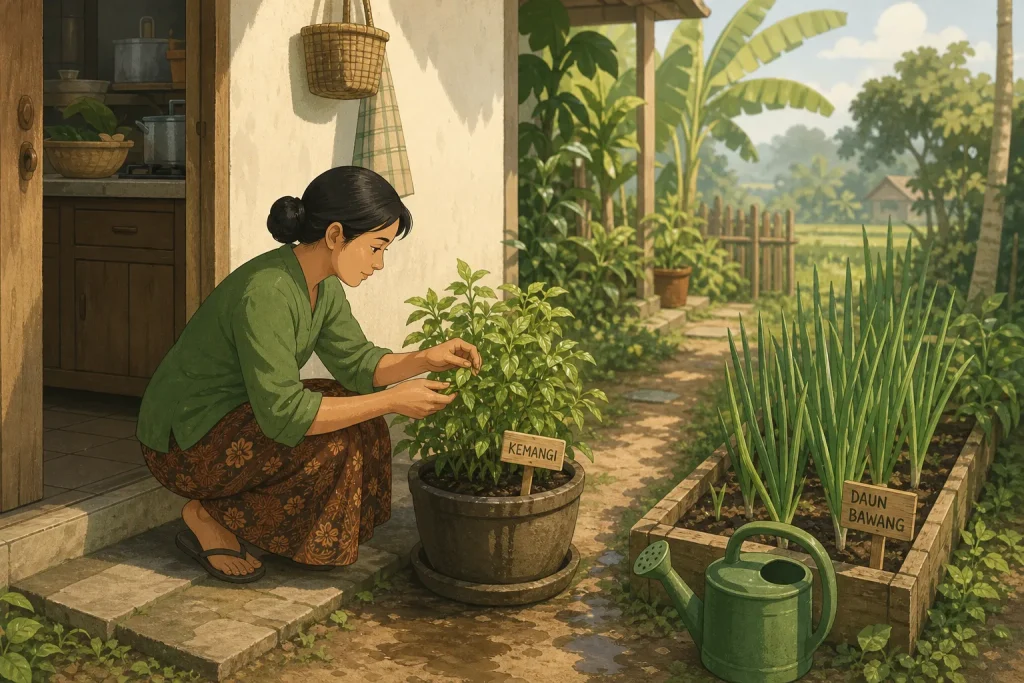
You are rinsing rice when the soup needs a final handful of leaves. A kemangi plant just beyond the kitchen door makes that small addition easy; a bed at the far end of the yard may not. For a kitchen herb patch in Blitar, begin with what you can observe at your own home rather than assuming every garden shares the same sun, drainage or growing conditions.
Watch the spot through the day, note where rainwater runs, and check the growing guidance for each plant you hope to grow. Local conditions can differ from one yard to another, so use plant labels and advice from a nearby grower familiar with your area when a herb’s needs are unclear.
Read the spot
Before preparing the ground, look at the proposed bed in the morning, near midday and later in the afternoon. Note where direct sun reaches, where a roof or wall casts shade, and whether a tree filters the light. A doorway can look bright while the ground beside it stays shaded for much of the day.
Do not assume that kemangi, daun bawang or any other herb will suit a particular exposure simply because it is commonly grown nearby. Check the plant’s label or ask a local gardener about its needs, then compare that advice with the light you have observed. If you are unsure, start with a movable pot so you can adjust its position and watch how the plant responds.
Notice water as well as light. Roof runoff may leave one corner puddled, while an eave keeps another unusually dry. After rain or watering, check where water collects and where it drains. If runoff crosses the proposed bed, choose another spot or arrange the planting so it does not sit in the flow.
Make a rough sketch of the kitchen door, the route you walk, the tap or water container, regular shade and the wettest area. A few notes on paper can prevent an avoidable mismatch between a plant and its position.
Keep access easy
Stand at the kitchen door and consider how you will carry a bowl or small basket to the plants. A firm path helps when the ground is muddy. Keep the doorway clear and make sure you can reach the plants without stepping over another planting or leaning across a tangle.
Put the herbs you use most often nearest the entrance or at the front of the bed. Keep occasional-use plants further back, where they remain accessible without taking the easiest spot. If a plant spreads or grows bushily, leave room to trim it; a separate pot can help keep it from crowding its neighbours.
Think about water access. A nearby tap is convenient, but a watering can works if carrying it is comfortable. Avoid a layout that sends a hose across a narrow doorway or a busy cooking route. If the ground is unsuitable, use a sturdy planter with drainage holes and set it where escaping water will not make the path slippery.
Choose familiar herbs
Start with the ingredients that already appear in meals at home. Kemangi may be used with fresh dishes, while daun bawang can be handy for soups, eggs and noodles; your own cooking habits are the best reason to include either. For a less familiar herb, check that you can identify it and confirm that its growing needs suit the spot before making room.
Consider how you use each plant: do you want leaves, stems or frequent small pickings? Keep labels until the leaves are familiar, especially when young plants look alike. A wooden stick marked with pencil is enough to identify a planting and note when it went into the bed.
Say you cook rice and soup most evenings and usually finish with kemangi or daun bawang. You have a partly shaded strip beside the door and a brighter, more exposed patch farther along the path. You check the labels and ask a nearby grower whether the two herbs suit those observed conditions; suppose the advice is that the kemangi can be tried in a pot where it receives suitable light, while the daun bawang is better kept in a position matching its label. You place the kemangi pot near the door and the daun bawang where its guidance indicates, then watch for changes in the plants. The resulting arrangement keeps both within reach while leaving you able to move a pot if its position seems unsuitable.
Prepare the ground
Clear rubbish and competing weeds, taking care around pipes or roots close to the house. Loosen compacted earth with a hand fork or small hoe, rather than grinding it into fine powder. A hand trowel is useful for planting small herbs without making unnecessarily large holes.
Check how the soil handles water after rain or watering. If it stays puddled, use a raised bed or a container with drainage rather than placing a plant into persistently wet ground. If it drains freely, continue to observe it as weather changes; one inspection does not describe every condition.
If the soil needs improvement, mix in mature, well-rotted compost. Avoid fresh manure or material that is still decomposing, and do not bury young plants beneath a thick layer of compost. Shape the surface so water can move away from stems, and avoid building soil up against the house.
Set out plants
Arrange nursery pots on the ground before planting. Put taller or bushier plants where they will not shade smaller neighbours, guided by your observations and the growing advice for each herb. Place frequent-use plants nearest the path, then check that you can reach each one without leaning over another.
Follow the spacing on a plant label where available. Without guidance, leave room for growth and be ready to move or thin a plant if it presses against its neighbours. Water a dry root ball before planting; make a hole wide enough to accommodate it, set the plant at its former depth, firm the soil gently and water slowly.
For seeds or cuttings, follow the directions for that plant rather than treating all herbs alike. Keep a note of the plant name and planting date, along with whether its spot was sunny, shaded or affected by runoff. Those observations will help you decide what to move or try next time.
Water and pick
Check the soil and the plant rather than following a rigid watering schedule. If the soil near the surface is still damp, wait and check again; if it has dried, water at the base. Newly planted herbs need closer attention while their roots settle, and pots may dry differently from open ground.
If a plant wilts, inspect the soil before watering. Wilting can have more than one cause, so adding water without checking may not help. If you cannot identify the problem, seek advice from a local grower familiar with the plant and conditions.
Use clean fingers or small scissors to pick leaves, taking only what you need and avoiding stripping a young plant bare. Trim damaged leaves so you can inspect the plant more easily. For a herb you have not harvested before, check its growing guidance or ask a knowledgeable local gardener how to pick it.
Adjust as needed
As the bed fills out, notice which plants are thriving and which are awkward to reach. Move a pot rather than repeatedly struggling with it; thin crowded growth and pull small weeds before they establish. If one herb is rarely used, consider replacing it with something that features more often in your cooking.
- Check the light: If the bed receives the exposure recommended on a plant’s label, try that plant there; if the conditions do not match, choose a better-matched position or keep it in a movable pot.
- Check runoff: If water collects around the proposed planting, use a raised bed or a container with drainage; if it drains away, proceed while continuing to observe the soil after rain.
- Check the route: If you can reach the plant without blocking the door or stepping over another planting, keep it in that position; if not, move it nearer the path or clear the route.
- Check how often you use it: If a herb goes into regular meals, give it an easy-to-reach place; if it is seldom used, move it further back or give the space to a more familiar ingredient.
- Check plant identity: If the label and plant name are clear, keep the label until you recognise the leaves; if identification is uncertain, do not pick it and ask a knowledgeable local gardener.
- Check for crowding: If leaves or stems press against a neighbour, thin or move one plant; if there is room to reach and inspect each planting, leave the arrangement as it is.
- Check soil before watering: If the soil near the surface has dried, water at the base; if it remains damp, wait and check again rather than adding water automatically.
Keep a hand trowel, scissors, plant labels and watering can in a dry place close to the garden but outside the walking route. Think of the layout like a kitchen shelf: daily ingredients belong within easy reach, while occasional ones can sit further back. Let your notes, the plants’ condition and the advice suited to your local spot guide later changes.